
What Are Your Marketing Images Saying About Your Business?
A Q&A with Kelsey Riley on photography, storytelling, and helping people see what makes your brand different
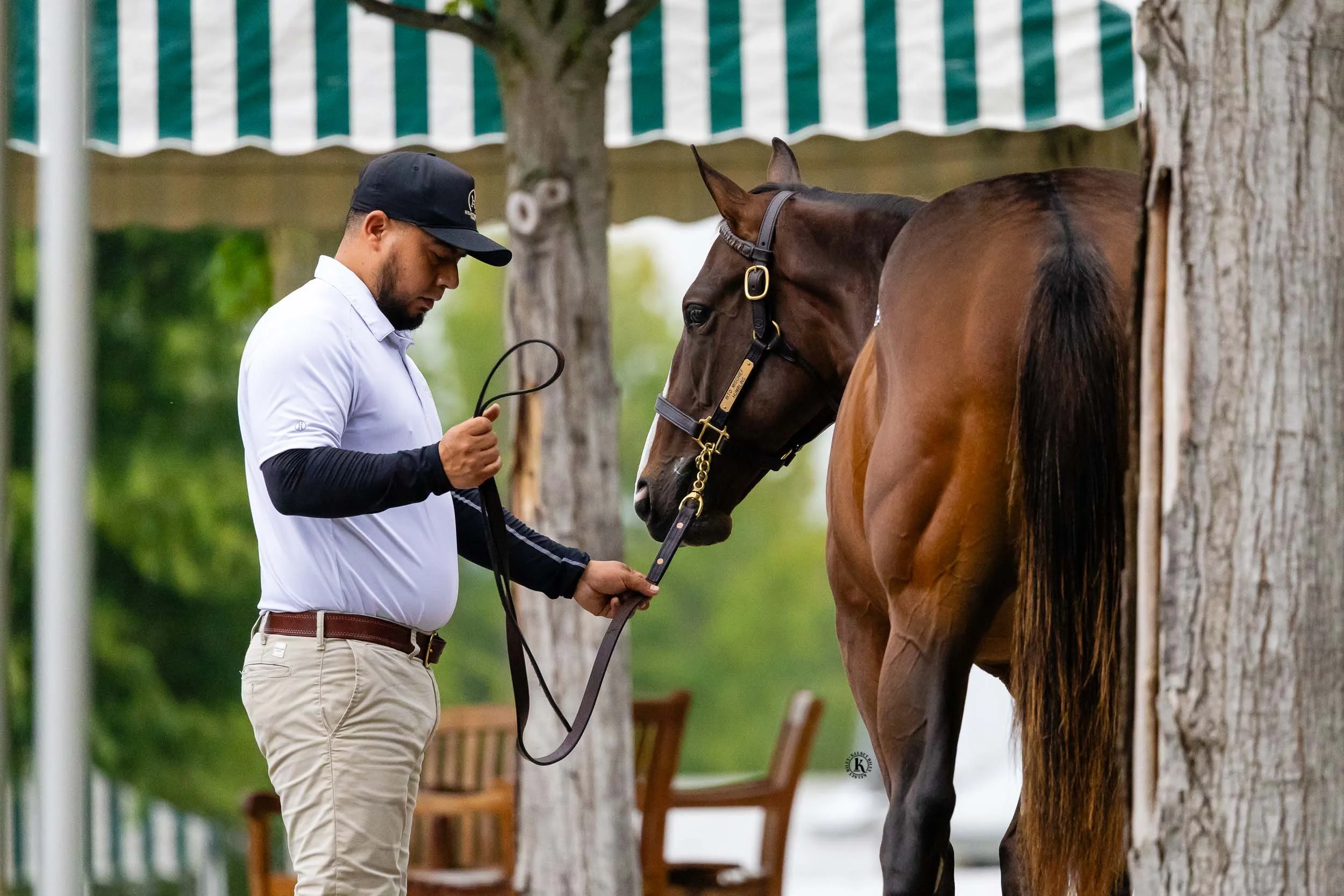
Everything says something.
Some images give us information. Others make us feel something.
Before someone reads a word of copy, those images are already telling a story.
The question is: Is it the story you want to tell?
Photography has never been more accessible. We now have access to tools that would have seemed impossible not that long ago.
But having more ways to create an image doesn’t necessarily make us better at seeing.
And maybe that’s where the more interesting conversation begins.
What if the best brand stories are already happening?
Businesses spend a lot of time trying to figure out what makes them different.
We workshop value propositions. We refine messaging. We develop brand standards. We think carefully about what should go on the homepage.
All of that matters.
But sometimes what makes an organization remarkable isn't something we need to manufacture.
That's what made me want to talk with my friend and colleague Kelsey Riley.
Kelsey is a journalist, marketing strategist, creative storyteller, photographer, and thoroughbred industry insider. Her boutique creative agency helps thoroughbred businesses build strong, recognizable brands through strategic storytelling, digital experiences, and compelling content.
But underneath all of that is something much simpler.
Kelsey loves horses. “I just love horses. I always have,” she told me. “I can't get enough of them.”
That love, combined with years spent learning the industry and telling its stories,
has shaped the way Kelsey sees through a camera.
And our conversation reminded me that good photography isn't about perfection.
It's about noticing what truly matters, and helping someone else notice it, too.
Three ideas that might change the way you think about your brand photography
The most meaningful photographs aren't always the most perfectly composed. Unexpected moments and small details can reveal more about your business than a carefully staged image.
The people behind your business may be your greatest differentiator. When products and services look similar, photography can reveal the relationships, expertise, and care that set you apart.
The strongest brand photography works as part of a larger story. Images, messaging, and the website experience need to work together.
Meg: You've spent much of your career telling stories about the Thoroughbred industry. Where did photography enter that story for you, and why did you decide you wanted to be behind the camera yourself?
Kelsey: I've always had an interest in photography and videography. I studied them a little in college and was able to dabble in them professionally and personally over the years, so I've always wanted to be behind the camera.
But the opportunity to jump much deeper into it came during my first year operating my own marketing business.
I had clients asking me to create content for them and manage their social media at the Thoroughbred sales. After doing the first few sales with my phone camera, I decided that investing in a mirrorless camera and a few nice lenses would not only level up the content I could create, but also provide added value to my clients.
Suddenly I was better equipped to capture high-quality photography and video they could use on their websites, social media, and throughout their marketing.
Meg: You've been around horses and horse people for years. What do you notice through a camera that you might not have noticed before?
Kelsey: One is the presence that a particular person or horse has. It's not always easy to explain or pinpoint, but some people and horses just have a presence that comes out beautifully in a photograph.
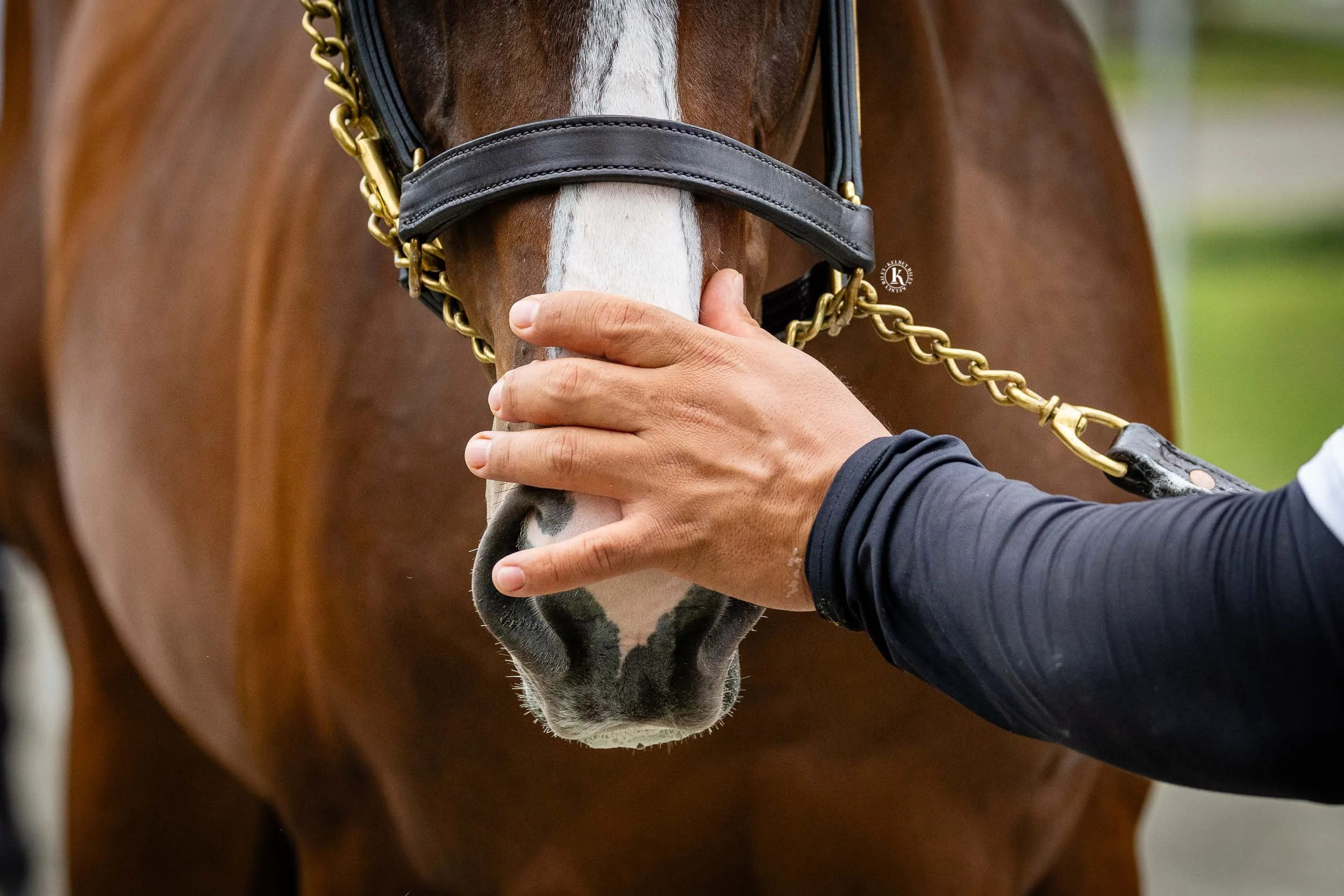
I also find myself noticing interesting little details: a horse with a unique color in its tail, or a person wearing a piece of jewelry or clothing that adds character to the shot.
Meg: Do you think having an “eye” for photography is something you're born with, something you learn, or maybe a little of both?
Kelsey: I think it's probably a little of both.
I've been told a lot that I “have an eye for it.” I would say my deep understanding of horses probably helps with that.
But now, even when I don't have my camera with me, I'm constantly looking at things in terms of how I'd photograph them.
Meg: When you arrive at a farm with your camera, what are you looking for? Are you searching for the beautiful shot, or for the moment that tells you something true about the people, horses, or place?
Kelsey: Both.
Where there are horses, there are going to be beautiful shots.
But it's also about conveying who the horses and the people behind them are.
My clients are people who put so much into their work with horses, and it's the greatest privilege to capture that hard work and dedication in photography and video—and help tell their stories.
Meg: Some of the most powerful brand photographs aren't perfectly posed. How do those seemingly small moments become part of a larger story?
Kelsey: With successful racehorses, it's about so many small moments that accumulate to create big successes.
I think when I first started, I'd take fewer shots because I was so focused on composing the perfect one.
But I learned pretty quickly that the best shots sometimes happen in unexpected ways.
So I stopped holding back and started trying different things on the fly.
Meg: That's interesting because there's a larger idea there for businesses, too. We can become so focused on presenting the polished version of ourselves that we overlook the moments that actually reveal who we are.
Kelsey: Absolutely. And in the Thoroughbred industry, that's especially important.
When you look at horse farms or sales consignments, the big picture and list of services can look very similar across many businesses.
And there are a lot of farms that are very good at what they do.
The differentiator is often the people and who you connect with as a potential client.
Photography is one very effective way to communicate who you are and why people should trust you.
Meg: That's something I think about a lot in user experience (UX) and website design. A potential customer may be comparing several businesses that, on paper, offer almost exactly the same thing. We have to help them understand, “Why you?”
Kelsey: Exactly.
And that's why photography has become such an important part of the work I do.
I don't sell a website package without photography included. That's how important I think it is.
I've even started using some of my own photography in my clients' advertising.
Many ads in horse-industry trade publications can look very similar. I've found that using creative photography rather than the standard racing or conformation photography can help my clients' ads stand out.
Meg: That's an important distinction. A beautiful photograph can't carry the whole experience. We have only seconds when someone lands on a website to help them decide, “Is this for me?” How do all of those pieces work together to build trust?
Kelsey: Images play a huge role, but all the elements of the site really have to work together.
Great images with poor copy and poor UX won't go very far.
But quality photography plays a big part in conveying a professional brand image. And repeated exposure to that photography across a website, advertising, and social media continually reinforces the quality and identity of the brand for its target audience.
Meg: So the goal isn't simply to have beautiful photography. It's to create something consistent enough that people begin to recognize and understand who you are.
Kelsey: Right.
Meg: After years of telling other people's stories, what has picking up a camera taught you about paying attention to the stories happening around us that we might otherwise miss?
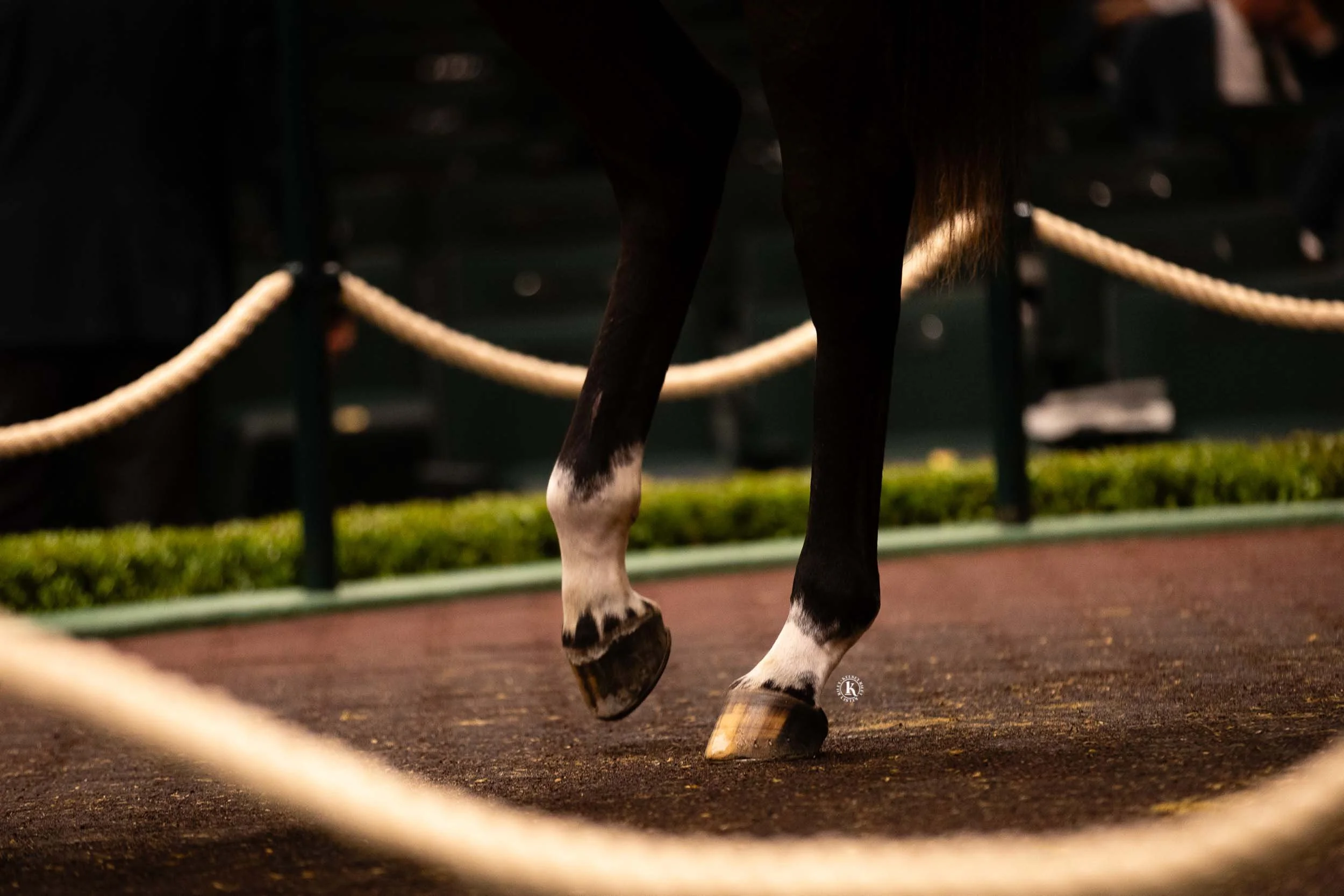
Kelsey: I think picking up a camera has taught me to pay attention to the micro-stories.
As a journalist at a horse sale, I'd talk to tons of different people and piece together lots of different stories.
Now, at the sales, I work with a select group of clients. I spend more time around fewer people and horses.
That gives me the chance to see how they work and interact with the horses day after day—and to capture little details I wouldn't have seen when I was a writer covering the entire sales ground.
It's a lot of fun working on the consignor side.
My clients have all been fantastic to work with. I've been with all of them across numerous projects, and with some of them, I was even there when they started their businesses.
I've seen what has gone into building those businesses, and I feel their successes like they're my own.
Maybe Seeing Comes Before Storytelling
There's something about Kelsey's last answer that stayed with me.
Pay attention to the micro-stories.
We often talk about storytelling as something we create.
Perhaps some of the best storytelling begins by noticing.
Before we decide what we want people to think about our organization, maybe we should spend some time looking at what's actually there.
How does your team care for your customers when nobody is watching?
What happens behind the scenes to make your product or service exceptional?
What does someone who loves their work look like while they're doing it?
What are the details you've stopped noticing because you see them every day?
Those moments aren't filler between the “important” photographs. They may be the story.
And when our photography, words, and digital experience all help people see that same story, a brand starts to feel less like something we've constructed and more like something true.
Two Ideas Worth Taking With You
1. Your differentiator may already be right in front of you.
When businesses offer similar products or services, differentiation doesn't always come from inventing something new.
Sometimes it's the people. The relationships. The expertise. The care. The way the work gets done.
Good photography can make those invisible differences visible.
2. The perfect shot isn't always the one that tells the best story.
Polish matters. Quality matters.
But sometimes the photograph that makes someone stop, feel something, or trust what they're seeing is the moment you couldn't have perfectly staged.
That's why telling a good story requires more than looking.
It requires paying attention.
Swayze Design Studio
Your business has a story worth telling. The challenge is understanding what matters most about that story and communicating it in a way that connects with the right people.
At Swayze Design Studio, I help purpose-driven businesses translate deep expertise into clear, supportive digital experiences, so your website guides, reassures, and connects at every touchpoint.
Clarity is kindness. Let’s design accordingly. Connect with Swayze Design.
Kelsey Riley
Kelsey is the founder of Kelsey Riley, a boutique creative agency serving the Thoroughbred industry. She helps farms, consignors, ownership groups, and trainers build strong, recognizable brands through strategic storytelling and digital experiences.
Her work includes website design, photography and videography, brand strategy, and ongoing marketing and content support, all informed by her deep experience within the Thoroughbred industry.
Learn more about Kelsey and her work: kelseyriley.co